Is your credit card working for you or against you? Take the 30-second test
Right now, your credit card company is making money off you, or you’re making money off it. One side wins each month, and most cardholders don’t know which side they’re on. You can find out in about 30 seconds. If you’re on the wrong side, you can flip it.
If you carried a balance over from last month and used your card today, even for coffee or gas, read the rule below first. It changes the math on every purchase you make.
How credit card companies make money
Card companies make money three ways, and each one comes from a different kind of customer:
- Interchange fees. Each time you swipe, the merchant pays a fee, often 1.5% to 3.5% of the purchase. You never see it, and the card company collects it whether you pay in full or not.
- Annual fees. Premium travel cards can charge $500 to $700 a year. Plenty of cards charge nothing.
- Interest. This is where card companies make most of their profit, and it comes only from people who carry a balance. The average rate on new card offers reached 23.96% in October 2026, according to LendingTree. For comparison, the stock market has returned about 10% a year over the long run.
Merchants decided long ago that card fees are worth paying, and you can avoid annual fees with a no-fee card. Interest is the trap. For the full breakdown, read how credit card companies make money.
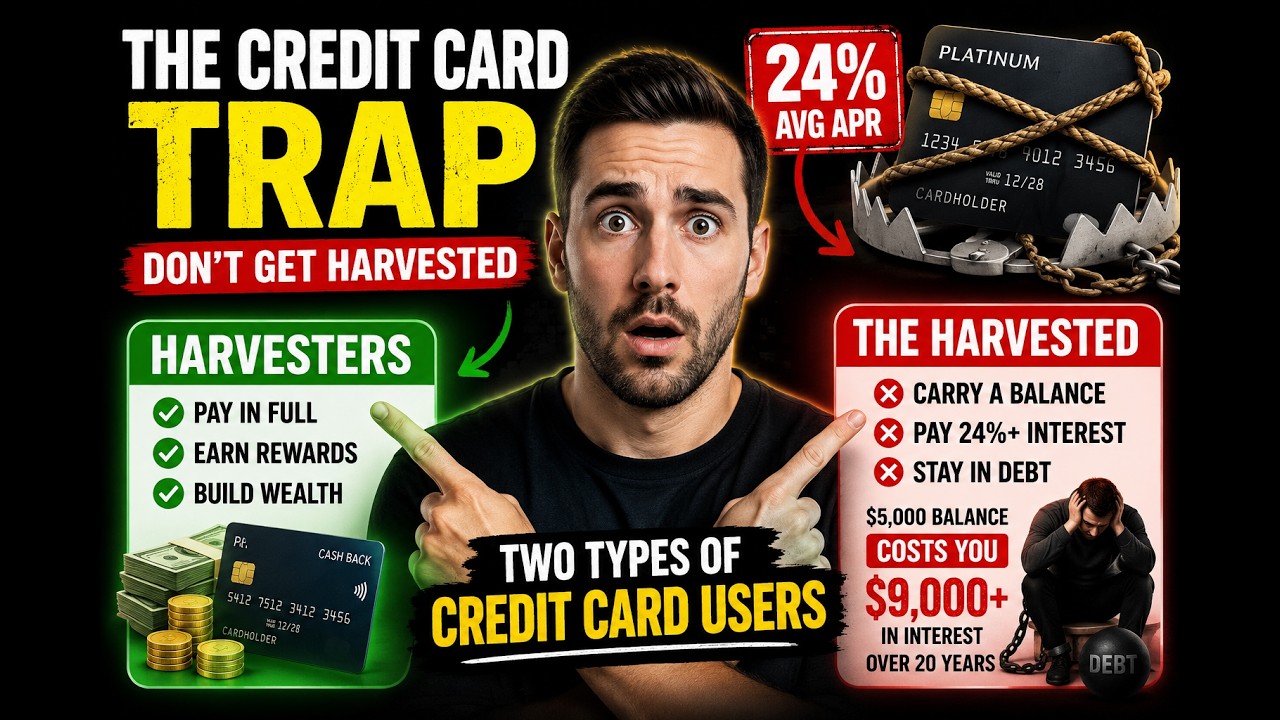
The two types of credit card users: harvester or harvested?
- The harvester pays the balance in full every month and never pays a dollar of interest. They collect cash back, points, and miles, and they get fraud and purchase protection. They borrow someone else’s money for a month for free. It’s a real-life Uno Reverse card.
- The harvested carries a balance, small or large. They pay about 24% a year on things they’ve already used up, thrown away, or forgotten. That dinner in February and that car repair in November are gone, and the interest is still there.
The test: do you pay your statement balance in full every month? The whole balance, not the minimum or most of it. If yes, you’re a harvester. If no, you’re being harvested.
The rule: never use a card that carries a balance
Your grace period, the 25 or so days when your purchases don’t charge interest, only applies when you paid last month’s balance in full. Carry a balance into the next month, and you lose it. New purchases start charging interest the day you make them. If your card carries a balance, that $50 grocery run you made today started costing you interest tonight.
Each time you swipe a card with a balance, you buy that item with a loan at about 24%. If a friend told you, “I found a great deal: I can borrow $60 for groceries at 24% interest,” you’d tell them it’s a terrible idea.
If you carry a balance on a card, put the card in a drawer and use a debit card for everyday spending until you pay it off. You don’t need to close the card. Closing it won’t erase the balance, and keeping it open can help your credit score.
How to get out of the credit card interest trap
If you’re carrying credit card debt, you may pay the minimum and watch the balance hold still, or throw extra cash at it when you can. Neither one fixes the interest problem. A debt consolidation loan can.
Depending on your credit, a consolidation loan might run 10% to 20%, compared with about 24% on your card. That rate gap alone can save you thousands of dollars. The structure matters as much:
- A fixed term, such as 24 or 36 months, so you know when you’ll be done
- A fixed payment
- A cap on the interest you’ll pay
A credit card has no finish line. Your issuer sets the minimum to keep you current, and paying only the minimum can keep you in debt for decades.
If you can get a debt consolidation loan with an APR at least two to three percentage points below your card’s rate, take it. Check several lenders. On our lending marketplace, choose debt consolidation or credit card consolidation as your loan purpose, then enter the amount you need and your credit score range. Apply with one of our featured lenders, and we’ll check your rate with up to 40 lenders behind the scenes. Our partners use a soft credit check, so applying won’t hurt your credit score.
Avoid the double-debt trap. If you pay off your card with a loan and then run the card back up, you’ve doubled your problem. The loan gets you out, and your habits keep you out.
A 0% balance transfer can work, too. You’ll pay a transfer fee, and you get a limited window: when the promotion ends, the card’s regular rate applies to whatever balance you have left. It can save you a lot of interest, but it takes more attention to get right. A consolidation loan is simpler and more predictable.
Carrying a balance? Compare consolidation loan offers with one application. The soft credit check won’t hurt your score.
The math: $5,000 on a card vs. a consolidation loan
| Card at 24%, minimum payments | Consolidation loan at 15%, 36 months | |
|---|---|---|
| First payment | About $150, then falling | $173, fixed |
| Time to pay off | About 19.5 years | 3 years |
| Total interest | About $8,890 | About $1,240 |
This example assumes a minimum payment of 1% of the balance plus interest, with a $25 floor. On the minimums, you pay for those $5,000 of purchases about two and a half times, and it takes you almost 20 years. With the loan, you’re out of debt in three years and keep about $7,650 in interest, or about $212 a month over those three years.
That’s a vacation, a used car, or several months of rent.
When credit cards are worth it
Use a credit card the right way, and it’s a great financial tool. Put the same $5,000 on a 2% cash-back card and pay it off the next month, and you come out $100 ahead. You paid no interest, and the merchant paid the interchange fee.
- A better credit score. Paying in full keeps your credit utilization low and builds a record of on-time payments. Both push your score up.
- Fraud protection. Under federal law, your liability for unauthorized charges on a credit card can’t exceed $50, and many issuers offer zero-liability protection on top of that.
- Purchase protection. Many cards extend manufacturer warranties and cover damaged or stolen purchases.
- Travel protection. Many premium cards cover trip cancellations, lost luggage, and rental cars.
Pay in full, and none of these benefits costs you anything. The card company pays for them with interchange fees, annual fees, and interest from the people who carry balances.
The gist
One habit decides which side you’re on: do you pay your full balance every month?
- If you do, keep using your card. Collect your rewards, use the protections, watch your credit score climb, and let merchant fees fund your perks.
- If you don’t, stop using the card. Look into a consolidation loan with a lower rate and a fixed end date, and once you’ve paid it off, don’t carry a balance again.