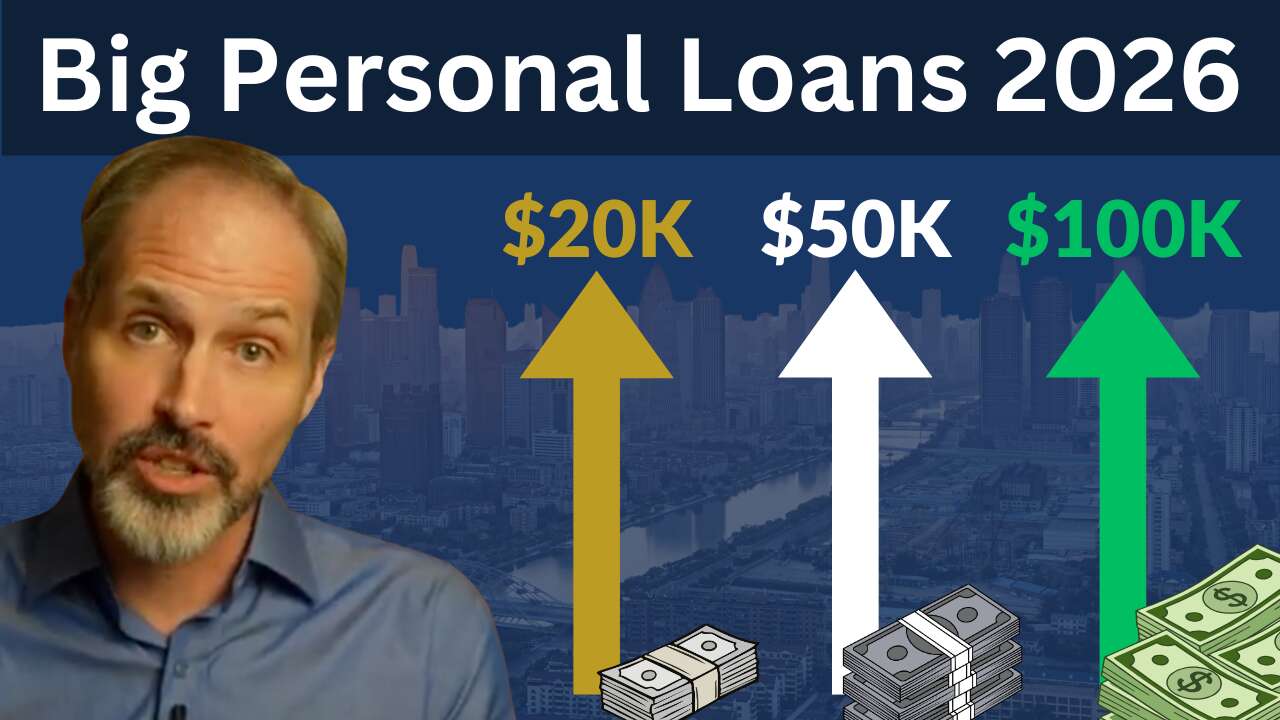
The Definitive Guide to Big Personal Loans in 2026: Where to Find $50,000 to $100,000
When you need to borrow a few thousand dollars for an unexpected car repair, your options are plentiful. Nearly every online lender, bank, and credit union offers small-dollar financing.
But what happens when your financial needs are substantial?
Entering 2026, the demand for “jumbo” personal loans—financing exceeding $20,000 and reaching as high as $100,000—is growing. Homeowners are choosing extensive renovations over moving in a tight housing market. Consumers are seeking to consolidate five-figure credit card balances into single, manageable payments.
The landscape for large-amount lending is vastly different than the small-loan market. The pool of lenders shrinks dramatically, the underwriting criteria become significantly stricter, and the stakes for approval are higher.
This guide explores the reality of securing big personal loans in 2026, identifies the lenders actually willing to cut checks for $50,000 or more, and provides the roadmap to getting approved.
The Reality Check: The “Jumbo” Loan Threshold
Before diving into specific lenders, it is crucial to understand that borrowing $50,000 is not five times harder than borrowing $10,000—it’s exponentially harder.
When a lender offers an unsecured personal loan of this magnitude, they are taking a significant risk. There is no house or car to repossess if you default. Therefore, they need near-absolute certainty that you can repay.
To qualify for the $20K–$100K tier in 2026, your financial profile generally needs to meet these three criteria:
1. The Debt-to-Income (DTI) Ratio Hurdle
This is often the dealbreaker for high income earners who are denied loans. Your DTI is the percentage of your gross monthly income that goes toward paying debts (mortgage, auto loans, student loans, credit cards).
For a jumbo personal loan, lenders prefer a back-end DTI (which includes the new loan payment) to be under 36%. Some may stretch to 43% for exceptionally strong credit profiles, but anything higher is usually an automatic denial for large amounts.

2. Credit Score Requirements shift upward
While some lenders might approve a $5,000 loan with a 620 FICO score, a $50,000 loan typically requires a score of 680 to 720+. To unlock the $100,000 tier at competitive rates, you should ideally be in the “Excellent” range (760+).
3. Verified, Substantial Income
You cannot state-income your way into a $100,000 loan. Lenders will require robust verification—W2s, tax returns, and bank statements. They need to see an income level that easily supports the new monthly payment, which could exceed $1,500 depending on the term and rate.
The Top Lenders for High-Dollar Personal Loans in 2026
While many lenders cap their offers at $35,000 or $40,000, the following six institutions have established themselves as the go-to sources for large personal loans in 2026.
1. SoFi (Social Finance)
The Heavyweight Champion for High Earners
- Maximum Loan Amount: $100,000
- Minimum Credit Score: Typically 680+
SoFi remains one of the premier options for borrowers needing maximum liquidity without collateral. They cater specifically to professionals with strong credit histories and high incomes.
Why it’s great for big loans: SoFi is one of the few lenders that offers unsecured loans up to $100k. They are notable for having no fees whatsoever—no origination fees, no prepayment penalties, and no late fees. They also offer unique member benefits, such as unemployment protection, which can temporarily pause payments if you lose your job—a valuable safety net when carrying a large loan balance.
The Catch: Their underwriting is rigorous. They place heavy emphasis on free cash flow (money left over after expenses).
2. LightStream
The “Gold Standard” for Excellent Credit
- Maximum Loan Amount: $100,000
- Minimum Credit Score: Typically 700+ (ideally higher for large amounts)
A division of Truist Bank, LightStream is known for offering some of the lowest APRs in the industry, often competing directly with home equity line of credit (HELOC) rates.
Why it’s great for big loans: Like SoFi, they cap at $100,000 with no origination fees. They offer a “Rate Beat” program where they will beat a competitor’s APR by 0.10 percentage points if you meet specific criteria. For borrowers with pristine credit looking to fund a massive home improvement project without tapping equity, LightStream is often the first stop.
The Catch: LightStream is notoriously selective. They require a long, stable credit history with a mix of account types. If your credit is merely “good,” you may be denied.
3. Best Egg
The Flexible Option for Debt Consolidation
- Maximum Loan Amount: $50,000 (Unsecured) / Higher amounts possible with Secured options.
- Minimum Credit Score: Typically 640+
Best Egg has carved a massive niche in the debt consolidation space. While their unsecured cap is often $50,000, they have begun offering secured personal loans that use fixtures in your home (like a built-in cabinet) or your vehicle as collateral, which may allow for higher approvals or better rates for those on the bubble.
Why it’s great for big loans: They are incredibly fast. Funding often happens within 24 hours. If you have “good” but not “perfect” credit and need $30k–$50k to wipe out credit cards, their approval odds are often better than SoFi or LightStream.
The Catch: Best Egg usually charges an origination fee (0.99% to 8.99%), which is deducted from the loan proceeds.On a $50,000 loan, a high origination fee means you might only receive $46,000.
4. LendingClub
The Marketplace Approach with Co-Borrower Options
- Maximum Loan Amount: Typically up to $60,000
- Minimum Credit Score: Typically 600+
LendingClub is a pioneer in online lending. As a marketplace bank, they act somewhat differently than direct lenders, matching borrowers with various funding sources.
Why it’s great for big loans: LendingClub’s biggest advantage for large loans is the ability to apply with a co-borrower. If you need $50,000 but your individual income doesn’t support the DTI requirements, adding a spouse or partner with income can significantly boost your approval odds and potentially lower your rate.
The Catch: Like Best Egg, origination fees are standard. Interest rates for those at the lower end of the credit spectrum can be high.
5. PenFed (Pentagon Federal Credit Union)
Low Fees and Credit Union Benefits
- Maximum Loan Amount: $50,000
- Minimum Credit Score: Typically 650+
You no longer need a military connection to join PenFed; anyone can become a member by opening a savings account with $5.
Why it’s great for big loans: As a not-for-profit credit union, PenFed is member-focused. They typically do not charge origination fees, making them cheaper than many online lenders even if the interest rate looks similar. Their rates are highly competitive for those with good credit.
The Catch: The application process can sometimes be slightly slower than fintech competitors like SoFi, and you must become a member to get the loan.
6. Happy Money
The Credit Card Killer
- Maximum Loan Amount: $50,000
- Minimum Credit Score: Typically 640+
Happy Money is unique because their loan product, “The Payoff Loan,” has a singular focus: eliminating high-interest credit card debt.
Why it’s great for big loans: If you need $40,000 specifically because you are drowning in credit card interest, Happy Money is designed for you. Their underwriting model looks beyond just the FICO score to assess financial health. They often pay your creditors directly to ensure the funds are used for their intended purpose.
The Catch: You generally cannot use this loan for home improvement or major purchases; it is strictly for credit card consolidation.
How to Shop for a $50K+ Loan Without Hurting Your Credit
When shopping for large loans, you cannot afford to submit formal applications to five different lenders. Each formal application is a “Hard Pull” on your credit report, which can temporarily lower your score and spook lenders—a disaster when trying to borrow $100,000.
Step 1: The Prequalification (Soft Pull) Every lender listed above offers a prequalification tool on their website. This uses a “Soft Pull” of your credit, which does not affect your score. You enter your income, desired amount, and basic info, and they tell you:
- If you are likely to be approved.
- The estimated interest rate and APR.
- The potential loan amounts.
Step 2: Compare APR, Not Just Interest Rate On large loans, fees matter immensely. The Annual Percentage Rate (APR) includes both the interest rate and any origination fees.
Example:
- Lender A offers 10% Interest Rate + $2,000 Origination Fee on a $50k loan.
- Lender B (like SoFi) offers 11% Interest Rate + $0 fee.
Despite the higher interest rate, Lender B might have a lower APR and be cheaper overall because you aren’t paying the upfront fee.
Step 3: Gather Documentation Early For large loans, automated income verification sometimes fails. Have PDF copies ready of your last two pay stubs, your most recent W2, and two months of bank statements to avoid delays in funding.
Detailed Frequently Asked Questions (FAQ)
Q: Is it harder to get a $50,000 loan than a $10,000 loan?
A: Yes, significantly. The risk to the lender is much higher with unsecured loans of this size. They will scrutinize your Debt-to-Income ratio much more closely and generally require a higher credit tier and a longer, more stable employment history than they would for a smaller loan.
Q: Can I get a $100,000 personal loan with bad credit?
A: In 2026, it is virtually impossible to get an unsecured $100,000 personal loan with bad credit (typically defined as a FICO score below 620). The risk of default is too high for reputable lenders. Borrowers with bad credit needing large sums usually need to look at secured options, such as Home Equity Loans, where collateral reduces the lender’s risk.
Q: What is the difference between a secured and unsecured BIG personal loan?
A:
- Unsecured: No collateral required. Approval is based solely on your creditworthiness and income. (e.g., Most SoFi, LightStream loans).
- Secured: You must pledge an asset, such as a car Title, savings account, or fixtures in your home. If you default, the lender can seize the asset. Some lenders, like Best Egg, may offer secured options to help borrowers qualify for larger amounts than they could unsecured.
Q: Why did I get prequalified for $50,000 but then denied after I applied?
A: Prequalification is a “best guess” based on limited data from a soft credit pull. The denial usually happens during the “hard pull” underwriting stage because:
- Your verified income was lower than the income you stated.
- Your DTI ratio was higher than it appeared initially once they saw all your monthly obligations on the full credit report.
- They found recent negative marks (late payments, collections) that didn’t show up on the soft pull.
Q: Should I use a personal loan or a Home Equity Line of Credit (HELOC) for a $75,000 renovation?
A: This depends on your financial situation and risk tolerance.
- HELOC Pros: Usually lower interest rates than personal loans; interest may be tax-deductible if used for home improvement; higher borrowing limits.
- HELOC Cons: Your home is collateral (risk of foreclosure if you default); variable interest rates (payments can rise); slower approval process requiring an appraisal.
- Personal Loan Pros: Unsecured (your house is safe); fixed interest rates and fixed payments; very fast funding (days vs. weeks).
- Personal Loan Cons: Generally higher interest rates than HELOCs; shorter repayment terms mean higher monthly payments.
If you need money fast and want a fixed rate without risking your home, an excellent-credit personal loan (like LightStream) is often preferred. If you want the absolute lowest rate and don’t mind a longer process and using your home as security, a HELOC may be better.
Q: How long can I take to pay back a large personal loan?
A: For loans over $20,000, lenders typically offer terms ranging from 3 to 7 years (36 to 84 months). Some lenders, particularly for massive loans up to $100k for home improvement, may stretch terms to 10 or even 12 years to make monthly payments more manageable, though this significantly increases the total interest paid over the life of the loan.
#PersonalLoans #Finance2026 #DebtConsolidation #BigLoans #MoneyTips