The Three Roles You Must Play to Pay Off Debt (And Build Wealth After)
Most people don’t stay in debt because they’re lazy, irresponsible, or bad with money. They stay in debt because they’re operating without a system.
They’re reacting instead of strategizing. They’re working harder, not smarter. And over time, that leads to frustration, burnout, and the belief that debt is permanent.
It isn’t.
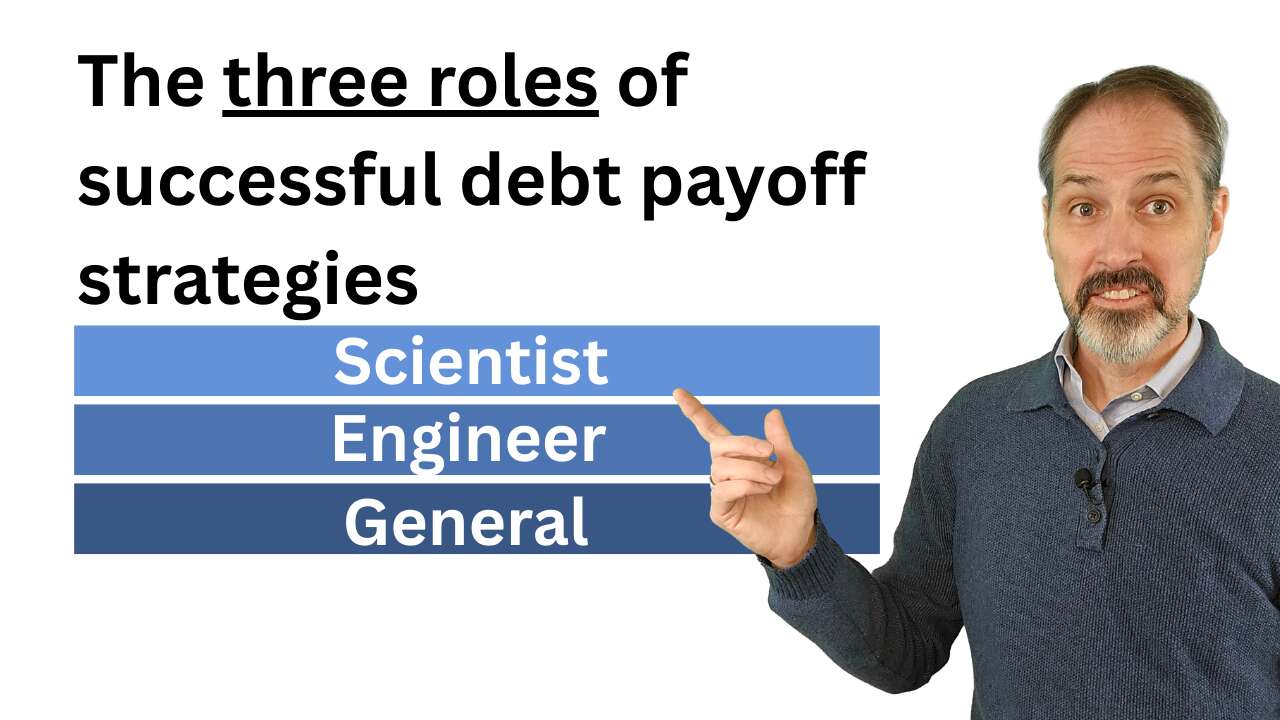
Paying off debt—and staying out of it—requires you to play three distinct roles at different stages of the process:
- The Scientist
- The Engineer
- The General
Each role has a purpose. Skip one, and progress slows or collapses entirely. Play them in the right order, and debt payoff becomes clearer, faster, and far more sustainable.
Role #1: The Scientist — Discover the Truth
A scientist’s job is simple: observe reality as it actually is.
When it comes to debt, that means removing emotion, guilt, and optimism—and replacing them with clarity.
Not All Debt Is the Same
One of the biggest mistakes people make is treating all debt as equal. It isn’t.
- Mortgages are often asset-building and tax-advantaged
- Medical debt follows different credit-reporting rules
- Credit card debt can stretch for up to 17 years if you only pay minimums
- Secured debt puts your collateral at risk
- High-interest debt silently drains your monthly cash flow
- Student loans (especially federal) can’t be discharged in bankruptcy and may capitalize unpaid interest
- Back taxes don’t appear on credit reports but carry extreme collection powers
- Child support and alimony can trigger civil contempt and wage garnishment
Each behaves differently. Each carries different risks. And each requires a different strategic response.
If you don’t understand those differences, you may work incredibly hard while making very little progress.

Study Yourself, Too
The scientist doesn’t just study the data—they study the subject.
You need to understand:
- What motivates you
- What discourages you
- Whether you value speed or stability
- What sacrifices are realistic
- What relationships and routines are non-negotiable
The “best” debt payoff plan on paper is useless if it collapses under real life.
Role #2: The Engineer — Build the System
Once the scientist has mapped the terrain, it’s time to design a solution.
Engineers live in the details. They understand that a brilliant design can fail if a single bolt is wrong.
This Is Where the Math Matters
As the engineer, you focus on questions like:
- What is the interest rate on each debt?
- How much of each payment goes to principal vs. interest?
- What happens if income drops?
- Where can this plan fail?
- What safeguards prevent relapse?
This is where strategies like:
- Debt snowball
- Debt avalanche
- Balance transfers
- Debt consolidation loans
…are evaluated objectively, not emotionally.
Tools like debt payoff calculators are invaluable here. They allow you to model multiple scenarios quickly and identify weak points before they cost you years of progress.
Role #3: The General — Execute Ruthlessly
Once the plan is built, hesitation becomes the enemy.
This is where you become the general.
Execution requires focus, discipline, and momentum. Every debt eliminated is a victory. Every balance reduced is territory reclaimed.
But here’s the critical warning:
You do not become the general first.
Without the scientist and engineer, intensity turns destructive. You risk:
- Burning out
- Damaging relationships
- Chasing bad strategies
- Working incredibly hard for minimal gains
With clarity and structure, that same intensity becomes unstoppable.
This Framework Doesn’t End at Debt Freedom
Once you’re debt-free, the roles don’t disappear—you just change the mission.
- Scientist → Understand investing, risk, and goals
- Engineer → Build wealth and retirement systems
- General → Execute consistently over decades
Debt payoff is just the first campaign. Wealth building is the long war.
Final Thought
Debt freedom isn’t about willpower. It’s about role discipline.
Know the truth. Build the system. Execute relentlessly.
That’s how you win.
Frequently Asked Questions (FAQs)
What is the most important role in paying off debt?
All three roles matter, but the scientist comes first. Without understanding your debt and yourself, any plan you build is likely to fail.
Can I use this framework if I’m already out of debt?
Yes. The same framework applies to wealth building, investing, and retirement planning. Only the objective changes.
Is this better than the debt snowball or avalanche method?
This framework includes those methods. Snowball and avalanche are tools—not strategies. This approach helps you choose the right tool for your situation.
How long does it usually take to pay off debt using this approach?
That depends on income, debt type, interest rates, and consistency. The advantage of this framework is that it minimizes wasted effort and prevents backsliding.
Should I consolidate my debt?
Sometimes. Consolidation can reduce interest and simplify payments, but only if the terms are better and spending behavior is controlled. This is an engineer-level decision.
What if my income is unstable?
That increases the importance of the scientist and engineer roles. You’ll need stronger safeguards, larger buffers, and more conservative assumptions.
Is motivation enough to stay out of debt?
No. Motivation fades. Systems persist. This framework prioritizes systems over emotion.
Can this work for couples?
Yes—but both partners must understand and agree on the roles, goals, and execution strategy. Misalignment is a common failure point.
What’s the biggest mistake people make?
Skipping straight to execution without understanding their debt or building a resilient plan.
What should I do first after reading this?
List every debt, its interest rate, balance, and risk. That’s the scientist’s first experiment.
#DebtPayoff
#GetOutOfDebt
#DebtFreedom
#PersonalFinance
#DebtStrategy
#FinancialDiscipline
#CreditCardDebt
#DebtMindset
#MoneyManagement
#FinancialPlanning
#DebtElimination
#WealthBuilding
#FinancialResilience
#MoneyEducation
#TheYukonProject
Disclaimer
This content is for educational and informational purposes only and should not be considered financial, legal, or tax advice. Individual financial situations vary, and strategies discussed may not be appropriate for everyone. Always consult with a qualified financial professional before making decisions regarding debt, credit, or long-term financial planning.